
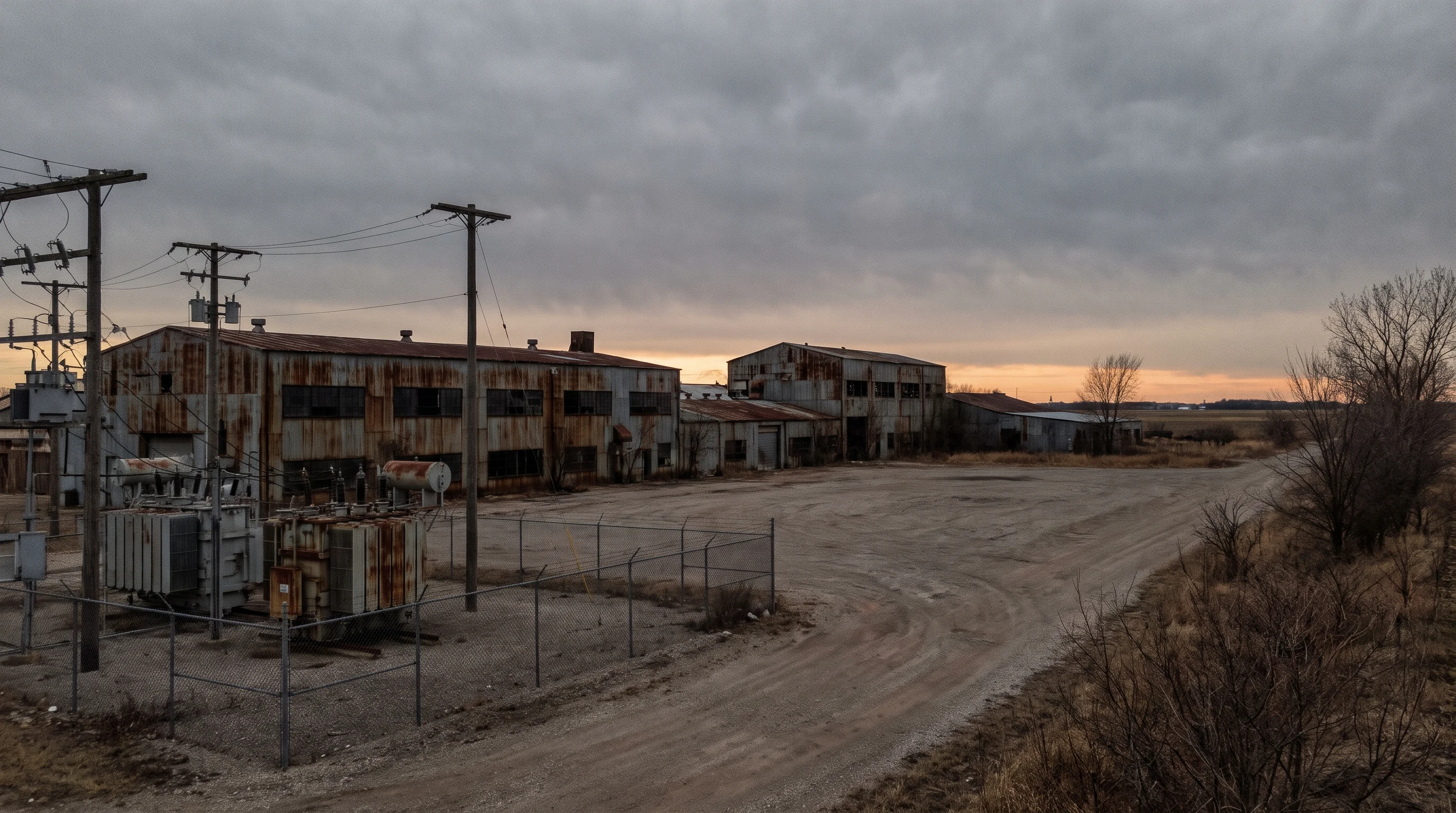
As many as 80% to 90% of proposed large-scale data center projects will not move forward, according to Kansas City-area broker Logan Freeman, who said power constraints and local opposition are pushing developers toward smaller deployments in shuttered industrial plants and existing commercial buildings.
Freeman, founder and managing broker of Midwest CRE Advisors in Overland Park, Kansas, said large-load capacity at the utilities he tracks, including Ameren, Evergy and Entergy, is committed through 2032. His clients are no longer planning beyond a three-year horizon.
“Guys, we’re already there. We’ve been there,” Freeman said on The PLOT on Nov. 24, when asked at what point regulatory risk stops large projects from getting built.
Freeman’s firm brokers data center sites, powered land and conversions alongside Kansas City investment sales. He said his work has ranged from 680-acre hyperscale campuses in Kansas to an enterprise colocation facility under 5 megawatts. PLOT has not independently verified his figures.
Idle plants with power in place
Freeman said demand is shifting to what he calls “energized brownfields”: closed meatpacking plants, sawmills and similar facilities of 400,000 to 500,000 square feet on roughly 20 acres, with 4 to 6 megawatts of existing electrical service.
Municipalities that lost their largest employer when those plants closed are courting the use, he said.
“They’re actually welcoming us and our clientele to their cities, rewriting zoning codes,” Freeman said. He said the firm is active in multiple Midwest municipalities. He did not identify them or his clients.
Developers are also targeting sites served by local electric cooperatives and unincorporated land, he said, and deploying in modular form: containers, office floors with a megawatt of unused capacity, and industrial buildings of about 25,000 square feet with nine-inch reinforced slabs capable of carrying racks that he said weigh 5,000 pounds.
Revenue-share deals for apartment and office owners
Freeman is also marketing smaller installations to owners of multifamily, office and infill industrial properties. Technology partners place half-height GPU racks in unused space and share revenue with the owner, a structure he compared to a rooftop cell tower lease.
A property needs unused space, spare electrical capacity and three-phase power to qualify, he said. In apartment communities, his firm is evaluating parking structures, underused surface parking, supply closets, former network rooms and down units.
Freeman said the economics work at the portfolio level only.
“To say that it could go impact one specific property extremely beneficially is, I think, untrue at this point,” he said.
His typical multifamily client owns 1,000 to 2,000 units. A syndicator with 1,500 units across four or five properties in one market could support up to 1 megawatt in total, he said.
He offers two structures. Institutional owners generally want to own the equipment and take the depreciation, while smaller owners prefer a revenue share on equipment the operator owns. He said smaller owners are typically looking for about $200,000 a year in added income.
Freeman did not disclose revenue per megawatt, equipment costs or how power costs are allocated between owner and operator.
”Don’t get too cute”
Freeman said the risk in the sector sits in capital structures, not in demand for power and land.
“The technology and the financing around this industry is more of a bubble than the actual fundamentals of it,” he said. On electrical equipment, transformers and sites, he said, “Demand is not the constraint there. Deliverable power is.”
His advice to sponsors: “Just be careful on how you finance this, and don’t get too cute.”
Enter your email to keep reading.
Get this story and every article on the site. Join 10,000+ professionals reading PLOT Daily. Free.